
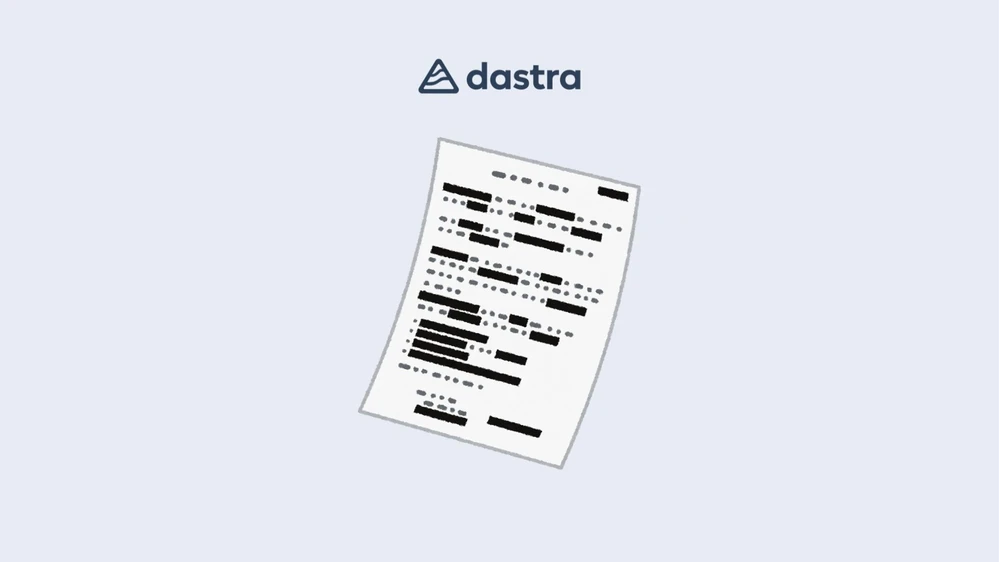

When handling a data subject rights request, providing a document to the requester is (very) often unavoidable: a copy of an ID, a contract, an account history, a customer file. These documents almost always contain information that cannot be disclosed as-is: data relating to third parties, internal contractual references, named individuals, etc.
Redacting these documents is a step in its own right when processing the request. Yet the way most organizations go about it today is both costly, time-consuming, and dangerously insufficient.
Dastra builds it directly into the workflow, without leaving the platform, with or without AI assistance.
What your “redacted documents” are really hiding
For years, legal and compliance teams have considered that placing an opaque block over a document is enough to conceal sensitive information. That is false, and data protection authorities regularly remind organizations of this. A visual mask applied to a non-flattened PDF can be removed in a matter of seconds, using any PDF editor, or even by a simple copy-paste into a word processor. The underlying text remains intact, readable, and extractable.
This is a compliance breach. Public authorities, law firms, and healthcare providers have transmitted supposedly redacted documents that in fact revealed third-party names, social security numbers, and confidential contractual information. In some cases, the consequences have been GDPR fines, litigation, and an irreparable loss of trust.
An operational cost that few organizations truly measure
Redaction is an expense item that often remains invisible in budgets, but very real in hours spent.
Take a concrete example: a company receives 200 data subject rights requests per month (access, erasure, portability...). Each request involves the transmission of one or more documents: account statements, contracts, customer files. Each of these documents must be reviewed, third-party data identified and masked, and the file checked before it is sent.
In practice, this ties up a lawyer or DPO for 15 to 45 minutes per case. Across 200 cases, that amounts to 50 to 150 hours per month dedicated to a repetitive task, highly prone to human error, that generates no added value but exposes the organization to sanctions if done poorly.
And that figure does not include indirect costs: often expensive third-party redaction tools, external legal providers brought in for complex cases, and the time lost switching between multiple software tools without a clear workflow.
When redaction becomes a compliance lever
The question is not whether your teams need to redact documents, but how they do it and at what cost.
A redaction tool integrated directly into the data subject rights request workflow fundamentally changes the equation. Dastra built this feature not as an add-on module, but as a native step in request processing: accessible from the transmission interface, without switching to another tool.
The contribution of artificial intelligence in this context is particularly significant: instead of line-by-line reviewing a 20-page document to identify third-party names, addresses, and identifiers, AI automatically suggests the areas to be masked. The human operator validates, adjusts, completes, and retains control over the final decision.
The resulting document is then rasterized, archived in the request file, and the original is retained for the compliance record. Traceability is complete, and risk exposure is minimized.
What this changes concretely for your organization
Beyond compliance, the challenge is to turn a burdensome task into a controlled process.
Organizations handling large volumes of requests know that data subject rights management is one of the most costly friction points in their compliance program. Redaction is often the bottleneck.
Faster processing also means a shorter response time: the GDPR requires a response to an access request within one calendar month. When redaction takes several days because the relevant lawyer is unavailable, or because the document must go through an external provider, meeting the deadline becomes difficult to guarantee.
Finally, there is the matter of trust. Sending a client a properly redacted document, on time, without exposing a third party’s data, is a strong signal of maturity in data protection. At a time when data breaches are regularly publicized, it is also a competitive advantage.
Compliant redaction is no longer an option
The GDPR introduced the principle of privacy by design: data protection must be built into processes from the outset, not added afterwards. Manual redaction (copy-paste, black rectangle, non-flattened PDF export) is the opposite of that principle.
Organizations that take compliance seriously can no longer afford to treat redaction as a peripheral manual task. It must become a structured, supported, and traceable process, just like managing the processing register or carrying out DPIAs.
That is exactly what Dastra has built: not yet another redaction tool, but an integrated building block that makes compliant redaction a natural step in data subject rights processing.
Compliant redaction with Dastra
Redact documents attached to a data subject rights request directly from Dastra, with or without AI assistance.
Assisted redaction
When redaction starts, the document is analyzed and areas likely to contain third-party personal identifiers are automatically detected: names, addresses, contact details, identification numbers. These areas are preselected directly on the document. The team removes false positives with one click and manually completes any missed areas before validating.
Manual redaction
For teams that prefer to keep full control, fully manual redaction is available in the same interface. The areas to be masked are selected directly on the document, with no automatic suggestions.
Generation of the redacted document
Once the review is complete, the redacted document is generated. The output file is rasterized: the underlying text is not merely visually hidden, it is made permanently inaccessible and cannot be extracted from the final file. The redacted document is automatically attached to the request and available for sending. The original is retained or deleted according to the organization’s policy.
For more information, see this article.
Best practices
Review before sending. The redacted document should always be reviewed before transmission. A missed or poorly delimited area may be enough to expose third-party data.
Keep the original. The unredacted original should be retained in the request file for your compliance record, unless your internal policy explicitly requires deletion.
Adapt the method to the document. For large or structurally complex documents (multi-page contracts, bank statements, medical files), manual page-by-page review remains essential, whatever detection mode is used.
Do not send the original by mistake. In a fast-moving process, there is always a risk of sending the wrong file. Make sure the document attached to the outgoing message is the redacted version, not the original.
Check metadata. Some PDF files contain metadata (author, comments, revision history) that may include confidential information. Make sure the generated document does not carry residual information in its properties.
Document redaction decisions. When a redaction decision is debatable (information partly related to the requester and partly to a third party), record the justification retained in the request file. This makes it easier to defend your position in the event of a challenge.
Dastra is a Privacy & AI compliance management platform designed for legal, DPO, and compliance teams. The redaction feature is available directly in the data subject rights management module.